
If you are not happy with the results, please do another search

Growing Green Finance in India: A Review of Green Bond Principles, Indian Green Debt Securities and ESG

The Grass is Greener Where You Water It

In 1970, American economist Dr. Milton Friedman opined a revolutionary idea on the purpose and responsibilities of business, which arguably propelled contemporary discourse on business responsibility and corporate governance. The idea questioned “what the doctrine of social responsibility implied and for whom.” Friedman, limiting his arguments to corporate executives (agents), acting on the discretion of the principals’ (stockholders, and not individual proprietors) interests – argued that the primary responsibility of business is towards stockholders and is restricted to making profits. Good, therefore, must be done at one’s own expense. From this view, individual proprietors were in the clear to simultaneously conduct business and invest toward social ends.

Dr. Friedman’s ideas nudged economists and scholars to consider the question of “for whom” social responsibility has implications. The responses devolved to include individuals and entities beyond the company itself, through what has commonly come to be known as the ‘stakeholder approach’ to business.

Amidst evolving discourse on global economic challenges and the role of corporations within this changing paradigm, the United Nations adopted the Paris Agreement, 2016 (“Paris Accords”) encapsulating global obligations towards climate change mitigation, sustainable investments and a low carbon future. The obligations under the Paris Accords may be considered as (i) co-operation based; or (ii) investment-based, towards fulfilment of the signatory countries’ nationally determined contributions. Pertinently, the investment-based obligations relate to (i) making finance flows consistent with climate resilience; and (ii) adopting diverse and appropriate financial and technological instruments. The Paris Accords also mandate that signatories concomitantly enable transparency of, and access to these arrangements.  There is, therefore, a discernible shift in the way we perceive not only the question of “for whom”, but also the “how” of investments, through evolving regulatory approaches.

Green Bond Principles: Global Investment Directives

Climate finance is a rapidly developing arm of international funding systems, with growing deliberations on the feasibility of employing financial instruments geared to meet the mandate under the Paris Accords. The Green Bond Principles (Voluntary Guidelines for Issuing Green Bonds) (“GBPs”) by the International Capital Markets Association (“ICMA”), define a ‘green bond’ as any type of instrument where the proceeds or an equivalent amount will be exclusively applied to finance, or re-finance, in part or in full, new and/or existing eligible green projects. Under the GBPs, green bonds may include:

  • Standard green bonds: A recourse-to-the-issuer based debt obligation.
  • Green revenue bonds: A non-recourse-to-the issuer-based debt obligation. Here, credit risk exposure under the instrument is pledged to the project revenue flows.
  • Green project bond: A recourse/non-recourse-to-the issuer debt obligation. Here, the borrower has direct risk exposure for green project(s).
  • Green securitised bond: A bond backed by green project(s), with the primary repayment source being the project revenue flows.


The GBPs comprise of 4 (four) main principles:

  • Use of proceeds: The GBPs recognize ‘green projects’ to include those oriented towards capital asset formation and operational expenditures, in (i) renewable energy; (ii) energy efficiency; (iii) pollution control; (iv) green buildings and real estate; (v) refurbished goods; and (vi) sustainable water management systems.
  • Project evaluation and selection: Green bond issuers are strongly encouraged to provide clear indications to prospective investors of the sustainability objectives and environmental perils associated with the instrument.
  • Management of proceeds: The allocated and unallocated net proceeds should be managed effectively and intimated to investors during the stages of fund disbursement and usage.
  • Reporting mechanisms: Issuers are encouraged to maintain transparent and accurate records of fund allocation and fund usage, to facilitate impact assessment and end-uses of green bond proceeds.


The GBPs recommend that issuers (i) align their green bond frameworks with the GBPs while making such frameworks easily accessible to potential investors; (ii) appoint external reviewers to conduct a preliminary assessment of their green bond frameworks viz the GBPs; and (iii) appoint external auditors to verify tracking and green bond proceeds management, post-issue.

Green Bonds in India: Identification, Investment and End-Use

Classifying Green Debt Securities

In April 2021, India’s central bank, the Reserve Bank of India (“RBI”) joined the Central Banks and Supervisors Network for Greening the Financial System (“NGFS”), as a member. The NGFS was launched at the Paris ‘One Planet Summit’ in 2017, and is a global network of banks endeavouring to develop best practices towards climate risk management. At present, the RBI, among other regulators, is reviewing the feasibility and opportunities for green finance, to support a shift towards sustainable economic growth.

Further, regulations and guidelines issued by the Indian securities regulator, the Securities and Exchange Board of India (“SEBI”), govern the Indian green bond framework. The SEBI (Issue and Listing of Non-Convertible Securities) Regulations, 2021 define a green debt security as funds raised through debt securities, utilized for project(s) and/or asset(s) falling under any of the following broad categories:

  • Renewable energy (including wind, solar, bioenergy, and any other energy sources using clean technology);
  • Clean transportation;
  • Sustainable water management systems;
  • Energy efficient and green buildings;
  • Sustainable waste management;
  • Biodiversity conservation; and
  • Any other category specified by the SEBI, from time to time.


Green Debt Securities: Reporting & Disclosures

In addition to the disclosure requirements under the SEBI (Issue and Listing of Debt Securities), 2008, the SEBI has also mandated disclosure requirements for issuers of green debt securities, including:

  • continuous review and assessment of identified green project(s) and/or asset(s);
  • continuous disclosure of utilized and unutilized proceeds;
  • ensuring that all project(s) and/or asset(s) funded by the proceeds of green debt securities, meet their documented objectives; and
  • offering qualitative and quantitative indicators on the environmental impact of the project(s) and/or asset(s); and
  • verifying proceeds and internal tracking mechanisms, through external auditors.


The legal framework on green debt securities (“SEBI Green Framework”) has also been made available on the SEBI portal. It may be argued therefore, that the SEBI Green Framework runs parallel to the GBPs.

ESG and Sustainability Regulation

In conjunction with financial regulatory changes, governments are also creating frameworks for sustainable corporate responsibility; particularly through environmental social and governance (“ESG”) regulation.  ESG factors are typically non-financial factors used to identify investment opportunities, challenges, and end-uses.

In India, Regulation 34 of the SEBI (Listing Obligations and Disclosure Requirements Regulations, 2015 (“SEBI LODR”) mandates that the top 1000 (one thousand) entities (based on market capitalisation) must include in their annual report, a mandatory business responsibility report (“BRR”), or a voluntary business responsibility and sustainability report (“BRSR”) listing the ESG initiatives taken by the company. However, under the SEBI LODR, the BRR submission requirement would be discontinued post the financial year 2021-22 and would stand replaced with the mandatory submission requirement of a BRSR.

It is pertinent to note, the corporate social responsibility framework under the (Indian) Companies Act, 2013 and extant rules, aligns regulation on eligible green CSR activities, annual reporting, and impact assessments – to support the adoption of best corporate governance practices.

Looking ahead

The framework for green debt securities may be amenable to further changes, subject to regulatory approaches taken. At the same time, regulators appear cognizant of the challenges in growing green finance, including among others (i) ‘greenwashing’ (that is, inaccurate representations of an entity’s environmental soundness); (ii) absence of accepted global standards and industry terminology (for example, what would definitively constitute a ‘green’ project); and (iii) metrics of environmental compliance.

Interestingly, global regulatory approaches may in certain respects align with Dr. Friedman’s views on economic externalities, such as environmental pollution.  Shortly after proposing the ‘stockholder approach to business’, Friedman in 1979 advocated for emission control, through taxation.

Today, removed from regulatory concerns – the market itself is interested in and responsive to more diverse financial instruments. One may argue therefore, that deepening investor interest in ESG principles and corporate sustainability compliance, reflects evolving conceptions of ‘profit’ and ‘rationality’ in the business ecosystem.


SEBI’s views of accessibility and legibility

A summary of the Accessibility Guidelines are as follows:

Quick Response Code (“QR Code”)

For all draft red herring prospectuses (“DRHPs”) filed on or after April 1, 2022, the cover page of the DRHP, red herring prospectus or prospectus(“offer document”) should contain a QR Code which links to a separate page on the website of the lead merchant banker (colloquially known as the left lead), where the offer documents, abridged prospectus, any corrigenda or addenda, and price band advertisement is available.

The QR Code should lead through not more than one click through filter (for jurisdiction specific restrictions or disclaimers) to the offering material.

Non-left lead merchant bankers may continue to upload the document based on current practices.


Content of offer documents

Cover Page: To ensure legibility, the Accessibility Guidelines sets out that the cover page of offer documents (containing the QR Code), should be at least font size 10 with utilisation of margins to ensure space for the increased font size.

Financials: Financial statements should be included in a manner such that legibility is ensured, including through use of landscape formats and narrower page margins.

Capital Structure: Details of allottees should be included in the table itself to the extent possible, especially for allotments to promoters, members of the promoter group or institutional shareholders. Only disclosures on allotments to employees or a large number of allottees should be provided in paragraph form through footnotes.

Risk Factors: Language in risk factors should be simplified to avoid repetition within and across risk factors. Percentages, wherever are mentioned, should be accompanied with corresponding numerical amounts. Data, as much as possible, should be presented in a tabular format for better understanding and legibility.


SEBI Observation responses and UDRHP

SEBI Responses: SEBI response should be properly formatted and with font size of at least 10. Responses provided to SEBI observations should clearly indicate whether the information is proposed to be disclosed in the offer document or is for SEBI’s review only. If data is not proposed to be disclosed, the rationale for the same should be clearly mentioned.

UDRHP: Changes to offer document as a result of SEBI observations should be highlighted in a different colour, in the comparison submitted to SEBI, for easier review.


Main board listing

All advertisements relating to an issue, should clearly disclose that the securities will be listed on the main board or on SME platforms. Similar disclosures to be made in case of advertisements for rights issues.


This blog is written by Pracheta Bhattacharya and Harish Choudhary.

International Women’s Day 2022 – Inspiring Story #5

We asked Archana about her journey and here is what she has to say:

What inspired you to pursue your passion for supporting social/community causes? 

Not all children get the childhood they deserve, and so I try my best to work with schools that are trying to provide the most basic amenities and education to children. On an annual basis, I reach out to local NGOs which work with children, such as improving schools for underprivileged kids and together we plan and implement a project – I have been doing this exercise for the past few years. Apart from this I also regularly support and help a local school that takes in underprivileged children of all backgrounds. Education is the best enabler and will help these children to proceed further in life.


Tell us more about your journey and experience, as well as key achievements and learnings?

A few years ago, I worked with an NGO for the construction of a girls’ toilet/restroom building in a village called Maralwadi in Karnataka, India. It was eye-opening to see the difference it made to the students and teachers. Before this, female students used to drop out of school after reaching class 7/8 as the toilet facilities were unhygienic. This has now changed, and we have seen more girls continuing their education. I have stayed connected with that community and have gone back to help with a science lab in the school. Since then, I have worked with some NGOs and schools to set up science labs, procure benches, desks, and other infrastructure for schools, and contributed to a school for underprivileged children in Bangalore, Karnataka. The biggest learning has been to understand the value of money – I am now acutely aware of the privileges in my life. My regret is not being able to spend more time with the children in these schools – I hope I can invest more time in the future.


Have you faced any barriers being a woman? If so, how did you overcome them and key takeaways?

When I first started working, I quickly became aware that women in law faced several subtle and overt biases and stereotypes. Female partners in law firms would be seen as having no personal life if they were invested in their careers, others were easily dismissed as “not serious”.

Over the years there have been many occasions when I have faced gender-based discrimination; there have been occasions when people have in the very first meeting, asked if a male lawyer could be in the meeting in my place; people have chosen to speak to a man instead of me in a conference room. My approach to all of these instances has been to let my work speak for me – as one of the most inspiring ladies I know said “women have to work twice as hard to be considered half as good as men”.

What put me at ease was the realization that I did not need to work to prove myself to anyone else, I just needed to work hard to be a good lawyer, deliver the best outcomes for my clients and be a good human being, the rest would follow.


What is the most important message you want to send out to young women who wish to diversify/pursue similar interests?

Choose the path that works for you and keeps you happy – don’t be influenced by others’ notions of what your priorities should be. Value yourself.


If you could have dinner with three inspirational women, dead or alive, who would they be and why?

I am lucky to have some very inspiring women in my immediate family, who have always shown me the way. There are also several women I would love to meet and learn from, so it is indeed difficult to choose just three women.

It would be very interesting to meet Ms. Mckenzie Scott, listening to her speak about any part of her journey would be very interesting. I would love to know how she remains committed to philanthropy.

Salumarada Thimmakka is living proof of the difference one person doing everyday things can make to the planet.

Ms. Sudha Murthy, because one lunch with her would be a master class in humanity and humility.


#SHErocks #BreakTheBias #jsastories

International Women’s Day 2022 – Inspiring Story #4

We asked Sanchita about her journey and here is what she has to say:

What inspired you to pursue your passion for Sports?

The field of sports and athletics is greatly liberating. It is cathartic and rejuvenating to be out in the open, training pushing myself physically. Discovering my talent in sports was instrumental to rounding out my personal growth and development. Growing up watching brave, fierce women compete in the field of sports, inspired me to take my place alongside them.


Tell us more about your journey and experience, as well as key achievements and learnings.

Having represented my state (Jharkhand) at the national handball tournaments each year during 2007-2011 is an achievement close to my heart. It was a very fulfilling and empowering experience, which I consider to have shaped my personality and psyche.

On the academic front, I was awarded two gold medals by my University for outstanding academic achievement during my undergraduate study at National Law University Odisha, including one for being the female student with the highest marks in my batch.


Have you faced any barriers being a woman? If so, how did you overcome them, and key takeaways?

Being a woman in a historically male-dominated field like sports and law has always meant working harder and putting in more hours to make myself known and recognized at par with male peers. My key takeaway over the years has been to embrace my flaws and strengths and focus only on improving myself, without heed to external factors.


What is the most important message you want to send out to young women who wish to diversify/pursue similar interests?

My message to young women would be to claim your space, make yourself known, and never be apologetic for being the best at what you do. With a little confidence and lots of work, we can do anything that we set our mind to.


If you could have dinner with three inspirational women, dead or alive, who would they be and why?   

I would pick Hillary Clinton, for showing the world how to be a fierce and driven individual in the political arena and also behind the scenes. I would also like to dine with PT Usha, to discuss women in athletics and Padmashree Manjamma Jogathi, a brave transwoman dancer to discuss what it means to identify as feminine in today’s world.


#SHErocks #BreakTheBias #jsastories

International Women’s Day 2022 – Inspiring Story #3

We asked Ms. Vadassery about her experience and what prompted her to pursue this cause and here is what she has to say:

You are an animal activist and passionate about this cause. What inspired you to work towards creating awareness among the public about animal exploitation and abuse issues?

Before lockdown, my association with animals was limited to my local area. With the impression that COVID-19 spread via animals, people needlessly harmed quiet, lone community animals. One case that has stayed with me all this time was of a pregnant cat, who was abused with her paws burnt off and then flung to the corner of a street left to die. Fortunately, the street she was abandoned on was mine, and I immediately took her in to help her recuperate and survive. These experiences lead me to educate the common populace about the harsh realities our community animals face. They truly are victims of senseless violence, and my message to all is “If you cannot care for them, don’t harm them.”


Tell us more about your journey and experience, as well as key achievements and learnings.

As an animal welfarist, the journey has been challenging and gratifying. Each rescue has taught me a plethora of realities. The pain the animal feels that contrasted by the indifference people show. At times I am left wondering does humanity exists. Every life saved adds to my experience and a story to the page of my life. As far as achievements and learnings are concerned, the fact that I can help an animal, save a life and be human is an achievement.


Have you faced any barriers being a woman? If so, how did you overcome them, and key takeaways?

A lot of times, animals in distress are in isolated locations, or areas of the city deemed unsafe at odd hours. It is challenging to respond to these calls. Another challenge is dealing with law enforcement officials. Being heard and taken seriously is a struggle that every woman faces. It is no different for a female animal activist. Over the years, my commitment and resolve towards animal welfare have empowered me to tackle these challenges head-on. While it is always either a mental battle when I head out late at night or hyper-vigilance When I am rescuing an animal the look in the eyes of the animal in distress when they realize, they’re being helped and trust this makes it all worthwhile.


What is the most important message you want to send out to young women who wish to diversify/pursue similar interests?

My advice to young women is simple: be bold, be unyielding and be forthright. Any welfare work adds a whole new fulfilling and empowering dimension to your life. You will face challenges; witness truly gritty and disheartening visuals and it will always be an uphill battle. But, at the end of the day, that one life you change, will make every struggle worthwhile. My years of animal welfare work have helped me grow as a person and shaped me to be the woman I believed I was incapable of being. Society will label you crazy and unfit to be a part of it. I say those aren’t insults, those are compliments. So get involved, do your part and be the anti-social misfit you’re meant to be.


If you could have dinner with three inspirational women, dead or alive, who would they be and why?

Maneka Gandhi (Founder – People for Animals) is like-minded and actively helps us to be a voice for the voiceless.


#SHErocks #BreakTheBias #jsastories

International Women’s Day 2022 – Inspiring Story #2

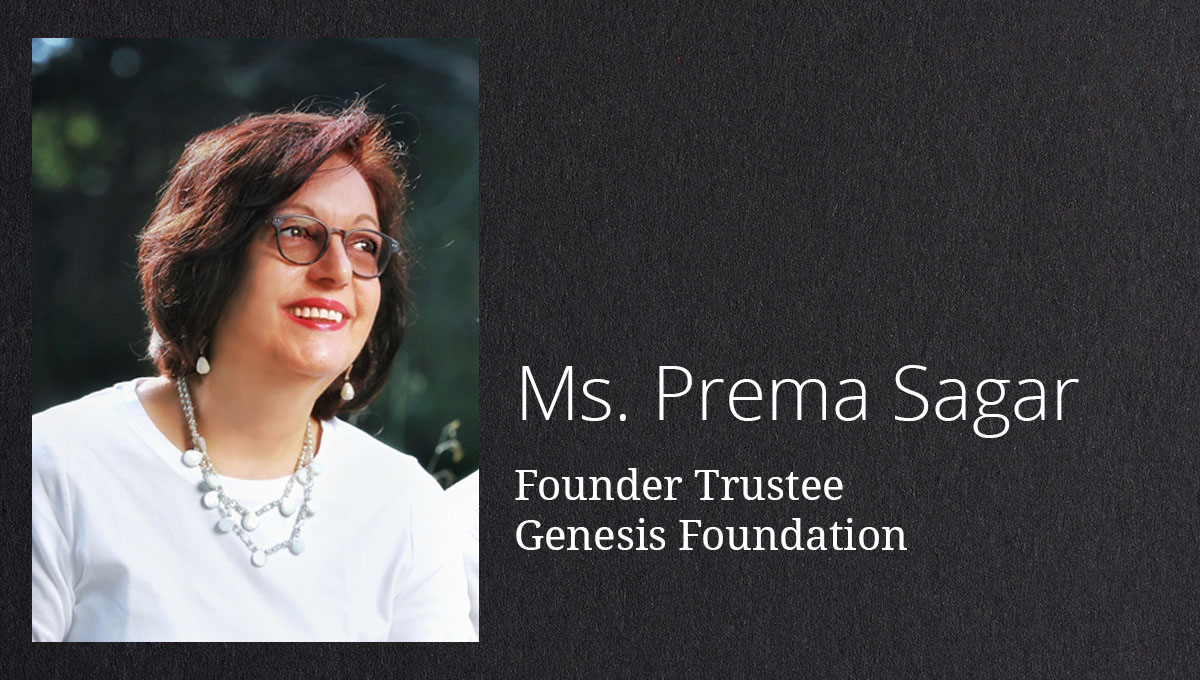
We asked Ms. Sagar about her journey and motivations and here is what she has to say:

What inspired you to start a children’s healthcare foundation in India?

Sometimes life throws challenges and sadness our way and as we find our way through that, we find our life’s purpose. On December 20, 1983, we lost our second-born child Sameer, to a Congenital Heart Defect within 16 hours of his birth. It took us a long time to recover and we spent a lot of time wondering why. There were no answers in sight and we were in a vacuum of sadness. In time, we channeled our loss and began volunteering at Missionaries of Charity, which gave a whole new meaning to our life. Not only did it heal us, it also gave us a way to extend healing to others. One by one, we met children we could support. In time, we decided to do it in a more structured way and started Genesis Foundation.

Tell us more about your personal journey and experiences, as well as key achievements and learnings

My journey has been a series of serendipitous events that led to me taking life decisions. There were many events before that but let me start with the time when I started a printing press with my brother. At that time, I would literally deliver the prints to my clients by hand. On one such visit, I met with Priya Paul of THE Park Hotels, who spoke to me about wanting to increase the occupation levels of the hotel. Together we developed ‘Going Public  at THE Park’, where we had inspiring people share their experiences. People would come to listen to them and experience the hospitality first hand. What we didn’t realize was that this was really public relations. In another such coincidental meeting, I was gifted a book by PR guru Frank Jefkins, and that prompted me to go to his institute in London to  study the theory and practice of PR . When I came back, I decided to start Genesis PR. That was almost 30 years ago, in November 1992.

We started with three people and three clients. Over the years, we grew, expanded to Mumbai and Bangalore, got acquired by Burson-Marsteller – a WPP group company. Later, B-M  merged with another WPP group company Cohn & Wolfe to form Burson Cohn & Wolfe, or BCW. In India, Genesis PR became Genesis Burson-Marsteller, which then became Genesis BCW. Six Degrees BCW integrated with us to form the BCW India Group. Today, I am proud to be the Founding Chairperson of BCW India Group, with Deepshikha Dharmaraj, who has been with us almost from the beginning, as the Chief Executive Officer.

This journey has taught me the value of three things: compassion, collaboration, and creativity. Compassion for our people and the community, collaboration with the industry, and creativity in everything we do –  which has led us to develop some of the pioneering concepts and solutions for the industry.

Have you faced any barriers being a woman? If so, how did you overcome them?

I have faced barriers, but I didn’t see them as something I faced as a woman necessarily. As I was building my business, there were several times that people didn’t take me seriously. However, as I gained experience and proved myself, people gave me respect. I also have a strong support system at home that enabled and empowered me every step of the way. I must thank my husband Jyoti in being there for me no matter what I was facing.

What is the most important message you want to send out to young women who wish to diversify/pursue similar interests?

I have always maintained that as women, we have to look beyond our gender, the way we expect others to look beyond ours. When I entered this field, I didn’t think of myself as a woman setting up a business in the early ’90s. I just knew that this is what I want to do and then got down to getting it started. Of course, I know and understand that women look up to me as a role model. So, to them, I will just say—dream big and then wake up and work hard to realize that dream.

If you could have dinner with three inspirational women, dead or alive, who would they be and why?

For me, there is only one: Mother Teresa – now Saint Teresa. She has been my inspiration for everything in life. Her compassion knew no bounds. Her courage and resilience in the face of adversity, criticism, and all kinds of hardship is truly inspiring. Her simplicity is something that I admire as well. She taught me the value of leading from the heart. I can go on and on about the lessons I have learnt from her life.  So, if it came to it, I would love to have three dinners with Mother Teresa.


#SHErocks #BreakTheBias #jsastories

International Women’s Day 2022 – Inspiring Story #1

We asked Juhi on her journey as a sportsperson and here is what she has to say:

What inspired you to pursue your passion in Sports?

Among the most vivid memories of my childhood, is watching Enter the Dragon with my father. Bruce Lee’s command over his body, his passion and discipline were evident even from a small tv screen. My fascination with martial arts coupled with the value of self-defence as expounded by my father led me to take up Tae-Kwon-Do as a 4-year-old girl. Given the lack of accessibility to teachers and classes two decades ago, when no one knew about Tae-Kwon-Do, finding any teacher was a mammoth task. My parents, conscious of my eagerness to learn, were able to find an instructor and I began taking classes. I cannot forget winning my first gold medal at an inter-school competition where I had to go up against a boy since no girl participated in my age group. In a world obsessed with gender, and physical strength that competition reminded me time and time again that I could do anything I put my mind to. At 8 years, I became the youngest black belt in India to be registered with the World Tae-Kwon-Do Association.


Tell us more about your journey and experience, as well as key achievements and learnings.

My parents and my instructors played a key role in keeping me motivated. Being involved in sports from a young age has taught me to learn from my failures as well as my success, because it is important to learn what you are doing wrong but also what you are doing right, so that no achievement is a fluke.  My biggest achievements would be winning gold and silver medals at various State and National level Tae-Kwon-Do championships, becoming the youngest Black Belt in India and having the opportunity to represent my District and the State of Haryana at the Tennis Nationals. However, being able to inspire my friends/acquaintances to take up sports is the biggest achievement of all.


Have you faced any barriers being a woman? If so, how did you overcome them and key takeaways?

My small stature meant that people would often question my ability to succeed in the sports I played be it Tae-Kwon-Do and/or tennis. Despite my successes in both sports,  I would be bullied over my muscular body. There was a pressure to succeed as a woman athlete but also to ‘look’ like a woman, to look ‘feminine’ enough; though I have never received a sufficient explanation as to what that means.  Coupled with the pressure you feel as an adolescent or a teenager to look a certain way, led to an inherent dissatisfaction with my physical appearance. I remember back in 2013-14, Women’s Tennis Association came up with a new campaign “Strong is beautiful” which included some of my favourite tennis players, their stories and how they embraced their strengths. This campaign helped change the way I viewed myself.

Further, I learnt that irrespective of what I did, I would be subjected to negativity by naysayers who would find problems with the way I played and with the way I looked, irrespective of what I actually did.   I found that the best thing to do when confronted with such negativity is to use that as fuel to your fire to succeed.


What is the most important message you want to send out to young women who wish to diversify/pursue similar interests?

I would just tell them to go for it. The worst thing that could happen is failure and it’s better to fail rather than to be too afraid to try. It’s never too late to pursue your passions and dreams. One thing that really worked for me was to use negativity from the people who doubt my abilities to motivate myself.  I think all of us are more powerful than we know. It’s just a matter of realising our own strengths which is the first step towards harnessing the power within us and accomplishing more in life.


If you could have dinner with three inspirational women, dead or alive, who would they be and why?

  • Ruth Bader Ginsburg was an icon for justice, perseverance and women empowerment. She shattered the glass ceiling and continues to inspire women across the world. Even if one does not agree with her beliefs and opinions, one cannot deny that she was a force to be reckoned with and that she left a meaningful impact on the world she inhabited.
  • Kim Clijsters is one of my all-time favourite tennis players who took a hiatus from tennis and returned in 2009 after having a baby. Despite widely being expected to retire having been away from professional tennis for almost two years, Kim Clijsters went on to win two Grand slams after her return. She exhibited to me that no matter where I am, it’s never too late.
  • Lisa Manobal is a Korean/Thai rapper from the K-Pop group Blackpink and a significant reason behind Blackpink’s rising international popularity. Lisa is one of the most influential, talented and well-rounded artists of our time and has been able to succeed in a country that is not her own. She is an incredible, dedicated performer and I really admire her focus on perfectionism.


#SHErocks #BreakTheBias #jsastories

Central and State Ministries: Important Guidelines, Notifications and Government Orders

The various Ministries and Departments of the State and Central Government have notified several important measures and guidelines in view of the COVID-19 outbreak.

The Ministry of Health and Family Welfare has been continuously updating guidelines and advisories in this regard. On the other hand, the other Ministries such as the Ministry of Corporate Affairs, Department of Consumer Affairs and the like have also, in conjunction with the Ministry of Health, announced several relief measures in their respective areas to ease the impact of the COVID outbreak on citizens and corporate entities.

A comprehensive list of such notifications and government orders can be accessed below:

  1. Ministry of Health and Family Welfare
  2. Ministry of Home Affairs
  3. Ministry of Corporate Affairs
  4. Central Drugs Standard Control Organisation and Pharmaceutical Department
  5. Insurance Regulatory and Development Authority
  6. Securities and Exchange Board of India
  7. Reserve Bank of India
  8. National Company Law Tribunal
  9. Department of Consumer Affairs
  10. Food Safety Standards Authority of India
  11. State Government

Relaxations provided by the Ministry of Corporate Affairs on 03 May 2021

The Ministry of Corporate Affairs (MCA) through a series of circulars issued on 03 May 2021 provided certain relaxations on (i) levy of additional fee for filing certain forms, (ii) timeline for filing charge related forms; and (iii) extension of time gap between two consecutive meetings of the board.

A brief of these circulars is provided below:

Relaxation on levy of additional fees in filing of certain forms:

In respect of forms that are due for filing during 01 April 2021 to 31 May 2021, MCA has granted additional time upto 31 July 2021 for companies/LLPs to file such forms (other than Form CHG-1, Form CHG-4 and Form CHG-9) without any additional fees. Accordingly, no additional fees shall be levied upto 31 July 2021 for the delayed filing of forms (other than the charge related forms as referred above) which were / would be due for filing between 01 April 2021 to 31 May 2021.

Relaxation of time for filing form related to creation or modification of charges:

Similarly, MCA has vide this circular, decided to allow relaxation of time and condone the delay in filing Forms related to creation / modification of charges, that is, in respect of Form CHG-1 and Form CHG-9.

ApplicabilityRelaxation of TimeFees
Where the date of creation/modification of charge is before 01 April 2021 and the timeline for filing such form has not expired as on 01 April 2021The period beginning from 01 April 2021 to 31 May 2021 shall not be reckoned for the purpose of counting the number of days under Section 77 or 78 of the Companies Act, 2013.If the Form is filed on or before 31 May 2021, the normal fees payable as on 31 March 2021 shall be charged.   If the Form is filed after 31 May 2021, the fees shall be charged per the applicable Fees Rules after adding the number of days beginning from 01 June 2021 and ending on the date of filing plus the time-period lapsed from the date of creation of charge till 31 March 2021.
Where the date of creation/modification of charge falls on any date between 01 April 2021 to 31 May 2021The period beginning from the date of creation/modification of charge to 31 May 2021 shall not be reckoned for the purpose of counting the number of days under Section 77 or 78 of the Companies Act, 2013.If the form is filed on or before 31 May 2021, the fees payable as on 31 March 2021 shall be charged.   If the Form is filed after 31 May 2021, the first day after the creation/modification of charge shall be reckoned as 01 June 2021 and the number of days till the date of filing the form shall be counted accordingly for the purpose of payment of fees under the relevant Fees Rules.

Non-Applicability: This circular shall not apply, in case:

  1. The Form CHG-1 and Form CHG-9 had already been filed before the date of issue of this circular;
  2. The timeline for filing these forms have already expired under Section 77 or 78 of Companies Act, 2013 prior to 01 April 2021;
  3. The timeline for filing these forms expires at a future date, despite exclusion of the time provided in ‘Relaxation of Time’ column above;
  4. The filing of Form CHG-4 for satisfaction of charge.

Relaxation of time gap between two consecutive board meetings:

Further, MCA has also extended the time gap between two consecutive meetings of the board. It has stated that the time gap may be extended to 180 days during the quarter April – June 2021 and the quarter July – September 2021, instead of 120 days as required under Section 173 of Companies Act, 2013.

Extension as Public Utility Service

Banking industry:

Services engaged in the Banking industry was earlier declared to be a Public Utility Service for purposes of the Industrial Disputes Act, 1947 Act (“ID Act”), for a period of six months from 21st October 2020 vide notification number S.O. 3548(E) issued by the Ministry of Labour and Employment.

However, on 16th April 2021 the Government of India extended the said period vide notification number S.O. 1722(E) issued by the Ministry of Labour and Employment and declared the services engaged in the Banking industry to be a Public Utility Service for purposes of the ID Act, for a further period of six months from April 21, 2021.

Manufacturing of Alumina/Aluminium and mining of Bauxite:

Similarly, services engaged in the manufacturing of Alumina and Aluminium and mining of Bauxite, was earlier declared to be a Public Utility Service for purposes of the ID Act, for a period of six months from 26th August 2020 vide notification number S.O. 2866 (E) issued by the Ministry of Labour and Employment.

However, on 16th April 2021 the Government of India extended the said period vide notification number S.O. 1721(E) issued by the Ministry of Labour and Employment and declared services of the industry engaged in the manufacturing of Alumina/Aluminium and mining of Bauxite (Items 30 and 31 respectively, of the First Schedule to the Industrial Disputes Act, 1947) to be a Public Utility Service for purposes of the ID Act, for a further period of six months from 16th April, 2021.