

India’s Real Estate Investment Trust (REIT) market has undergone a remarkable transformation over the past few years. Introduced to deepen capital markets and provide investors with access to income-generating commercial real estate without the attendant costs of owning the property, REITs have evolved into an important asset class for all categories of investors.
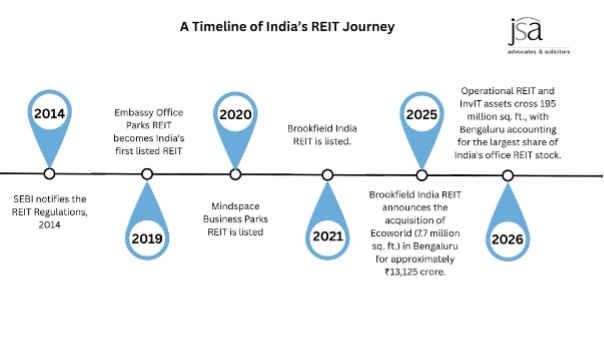
Recent reports indicate that the combined operational assets held by listed REITs and Infrastructure Investment Trusts (InvITs) have crossed 195 million square feet, reflecting the increasing institutionalisation of India’s real estate and infrastructure sectors. REITs and InvITs are investment vehicles, similar to the traditional investment vehicles such as, mutual funds. However, here, they pool money from multiple investors to invest in income-generating real estate and infrastructure assets, respectively.
Equally noteworthy is Bengaluru’s emergence as the country’s dominant office REIT market, accounting for the largest share of REIT-owned office assets.
However, Bengaluru’s leadership is not the result of a single transaction or a recent market trend. Rather, it is the culmination of years of sustained office development, multinational corporate expansion, regulatory reforms, and growing institutional investment into real estate.
This article examines why Bengaluru has become India’s office REIT capital and what this means for the future of India’s commercial real estate and capital markets.
Understanding India’s REIT Framework
India formally introduced the REIT aligned with global investment trust structures in 2014. The objective was to create a regulated investment vehicle that would enable owners of income-generating commercial real estate to monetise mature assets thereby freeing up capital while providing investors with access to professionally managed real estate portfolios.
Unlike traditional real estate ownership, REITs invest primarily in completed and revenue-generating assets. The framework requires a significant proportion of assets to be operational(thereby mitigating construction risks), mandates periodic distributions to unitholders, and imposes governance, valuation and disclosure obligations designed to enhance transparency and investor confidence.
Since the listing of India’s first REIT in 2019, the market has expanded with REITs comprising premium office and retail assets across major metropolitan cities.
Today, India’s listed REIT ecosystem represents one of the country’s most successful examples of integrating commercial real estate with public capital markets.
Why Bengaluru Stands Out
Among India’s major commercial centres, Bengaluru has consistently demonstrated characteristics that make it particularly well suited for REIT ownership.
The city possesses the country’s largest inventory of institutional-grade office space, supported by large integrated business parks, modern infrastructure and sustained demand from multinational corporations.
Unlike markets that depend heavily on domestic occupiers, Bengaluru’s office sector is anchored by technology companies, Global Capability Centres (GCCs), research organisations and multinational enterprises that typically enter into long-term lease arrangements.
These long-duration leases generate stable rental income, precisely the type of predictable cash flow that REIT structures are designed to monetise.
As a result, Bengaluru naturally emerged as the preferred location for India’s earliest office REIT portfolios.
The Data Behind Bengaluru’s Share of the REIT Market
According to industry estimates, Bengaluru accounts for approximately 33% share of all leasing activity by foreign occupiers in Q1 of 2026, making it the country’s largest office market by completed institutional-quality inventory.
Recent market reports further indicate that:
- Bengaluru accounts for approximately 24.7% YoY growth of India’s gross leasing;
- Nearly 30% of the city’s Grade A office stock is already held within listed REITs, reflecting the highest REIT penetration among major Indian cities;
- India’s listed REIT and InvIT assets now collectively exceed 195 million square feet; and
- Bengaluru continues to contribute a significant share of annual office leasing activity.
These figures illustrate that Bengaluru is not merely participating in India’s REIT market, it is shaping it.
The GCC Advantage
Perhaps the single most significant factor behind Bengaluru’s REIT dominance is the continued expansion of GCC.
India has become one of the world’s preferred destinations for multinational companies establishing technology, engineering, finance, analytics and research centres. Bengaluru, the original ‘Silicon Valley’ in India and the hub of information technology, remains the preferred destination for many of these operations due to its skilled workforce, established technology ecosystem and mature office infrastructure.
Unlike traditional office occupiers, GCCs with their stable rental profile often enter into large-scale, long-tenure lease agreements.
For REIT investors, this translates into:
- predictable rental income;
- lower vacancy risk;
- stable occupancy levels; and
- greater visibility of future cash flows.
Consequently, the growth of GCCs has strengthened the investment case for Bengaluru’s office assets and enhanced their attractiveness for REIT ownership.
Institutional Developers Created REIT-Ready Assets
Another defining feature of Bengaluru’s commercial real estate market is the scale of institutional investment undertaken over the past two decades.
Developers such as the Embassy Group, Prestige Group, RMZ Corp, Brigade Group and Sattva Group pioneered large integrated office parks that were specifically designed for multinational occupiers.
These campuses typically offer:
- Availability of sizeable floor plates
- Multiple office towers;
- Diversified tenant bases;
- Integrated amenities;
- Professional property management; and
- High environmental and sustainability standards.
These characteristics allowed sponsors to avoid assembling fragmented portfolios, and instead focus on monetizing large, stabilised assets through public markets, creating attractive investment opportunities for institutional and retail investors alike.
Implications for India’s Capital Markets
The growth of Bengaluru’s office REIT ecosystem extends beyond commercial real estate. It represents a broader shift in how institutional capital participates in India’s economy.
For developers, REITs provide an efficient mechanism to recycle capital from mature assets into new developments.
For investors, they offer exposure to income-generating commercial real estate through regulated, exchange-listed investment vehicles without any of the attendant issues associated with owning real estate in India.
For capital markets, REITs diversify available investment products while broadening participation across domestic and foreign institutional investors.
The increasing maturity of India’s REIT market also reflects growing confidence in regulatory oversight, corporate governance standards and disclosure practices.
In many respects, Bengaluru has provided the most visible example of how commercial real estate can evolve from privately held assets into publicly traded investment products.
What Lies Ahead?
India’s office REIT market is still at a relatively early stage compared with more mature jurisdictions.
As institutional ownership of commercial real estate expands, several trends are likely to shape the next phase of growth.
These include:
- continued expansion of GCC;
- increasing institutional ownership of office assets;
- additional REIT listings as developers monetise stabilised portfolios; and
- greater investor participation in listed REITs.
While Hyderabad, Pune, Chennai and the National Capital Region continue to attract significant commercial real estate investment, Bengaluru appears well positioned to retain its leadership given its scale, depth of occupier demand and concentration of REIT-ready office assets.
Conclusion
Bengaluru’s dominance in India’s office REIT market reflects the convergence of several structural factors: decades of Grade A office development, sustained multinational demand, the rapid growth of GCC and a regulatory framework that enables mature commercial assets to access public capital markets.
As India’s REIT ecosystem continues to evolve, Bengaluru offers a compelling illustration of how regulatory reform, institutional investment and commercial real estate can work together to deepen capital markets.
For developers, investors and market participants alike, the city’s experience may well serve as a blueprint for the next phase of India’s REIT journey.
This blog is authored by our Joint Managing Partner – Vivek K Chandy and Partner – Arka Mookerjee.






Arka Mookerjee is a Partner and Co-Head of the Equity Capital Markets practice, with over 21 years of experience advising on India’s most complex and high-value transactions. Widely recognised for pioneering mandates—including India’s first QIP and InvIT IPO—he represents issuers, underwriters and investors across capital markets and investment structures. Arka actively engages with regulators and industry bodies, playing a key role in shaping India’s evolving capital markets framework.